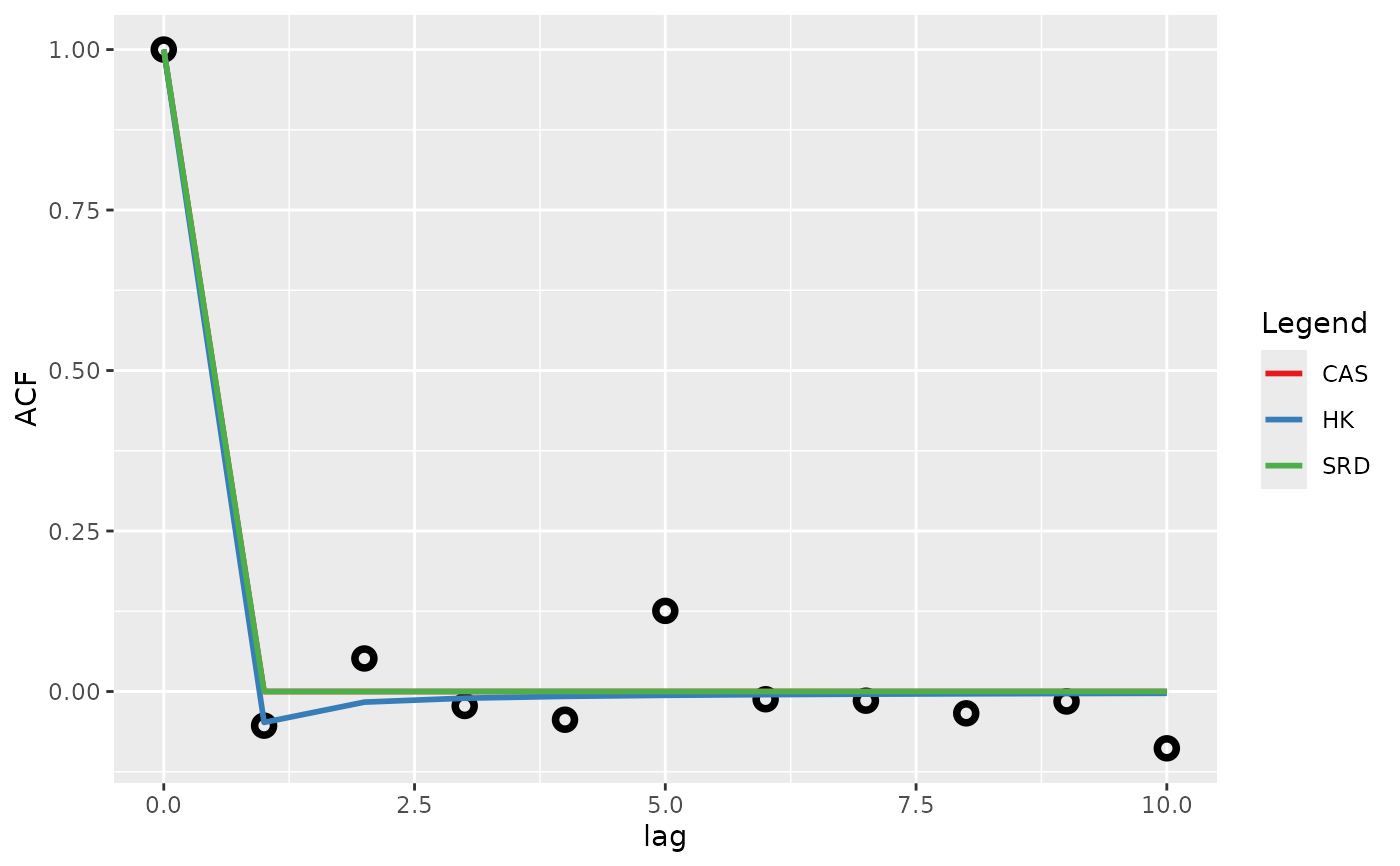
Fits one or more theoretical autocorrelation functions to
the sample ACF of an xts series. Three parametric models are
available: the Cauchy-type autocorrelation structure (CAS, a
two-parameter model with algebraic decay), the Hurst-Kolmogorov
process (HK, a one-parameter fractional Gaussian noise model), and
the short-range dependence model (SRD, a one-parameter exponential
decay). Parameters are estimated by minimising the root-mean-square
error between the theoretical and sample ACFs up to
lag_max, using the L-BFGS-B optimiser with positivity
constraints on all parameters. The function returns fitted parameter
vectors for each model type, a data frame of theoretical ACF values at
each lag, and a ggplot overlay of the fitted curves on the
empirical autocorrelation.
Usage
fit_ACF(
  ts,
  lag_max,
  type = list("CAS", "HK", "SRD"),
  ignore_zeros = FALSE,
  zero_threshold = 0.01
)
Arguments
- ts
An xts object containing the time series data.
- lag_max
Integer. Maximum lag to use in fitting.
- type
Character vector of ACF model types. Options are
"CAS","HK", and"SRD". Default all three.- ignore_zeros
Logical. If
TRUE, values belowzero_thresholdare excluded. DefaultFALSE.- zero_threshold
Numeric. Threshold below which values are treated as zero. Default
0.01.